Introduction
Gǔqín 古琴, also known simply as qín 琴 (gǔ 古 means “ancient”), is a seven-string Chinese zither considered one of the oldest and most prestigious instruments in the Chinese musical tradition. Unlike other instruments designed primarily for public display or festive accompaniment, the gǔqín was historically linked to self-cultivation, intellectual reflection, and aesthetic sensitivity.
For centuries, it was the preferred instrument of scholars, officials, and educated elites. In classical Chinese culture, mastering the qín formed part of the ideal of the cultivated gentleman, alongside strategic board games (wéiqí 圍棋), calligraphy, and painting.
More than a mere musical instrument, the gǔqín was understood as a means to order the mind, refine character, and harmonize the individual with the surrounding world.
In 2003, UNESCO recognized the gǔqín and its music as an Intangible Cultural Heritage of Humanity, acknowledging its historical and artistic significance.
Main characteristics of the gǔqín
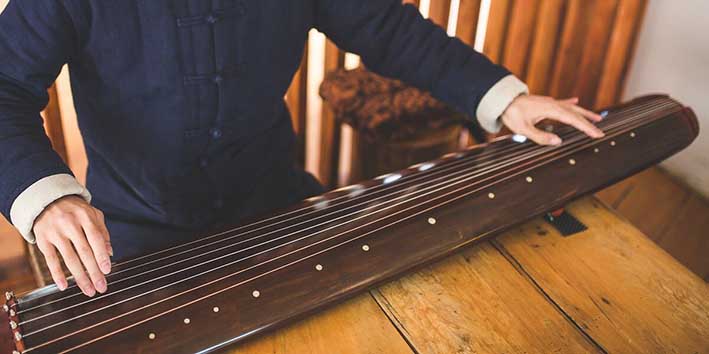
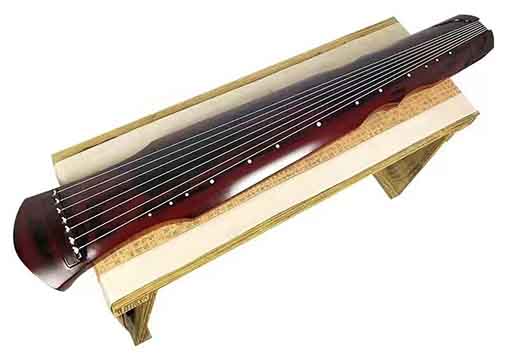
The gǔqín has an elongated and austere shape, usually constructed from lacquered wood, most commonly paulownia. Its traditional length is three chǐ 尺, six cùn 寸, and five fēn 分 (approximately 121.7 cm), a symbolic measurement associated with the 365 days of the year in traditional Chinese cosmology.
Today it has seven strings, although ancient sources and archaeological findings indicate that earlier variants existed with different numbers of strings.
Unlike many other Asian zithers, the gǔqín has no raised frets. Thirteen inlaid markers called huī 徽 appear on its surface, serving as reference points for positions and harmonics.
Its performance technique combines three principal types of sound:
-
Sàn yīn 散音 or open string tones: the right hand plucks the strings without intervention from the left hand, producing the natural sound of the string.
-
Àn yīn 按音 or pressed string tones: the right hand plucks while the left hand presses the string at different points to obtain various pitches.
-
Fàn yīn 泛音 or harmonics: the right hand plucks while the left hand lightly touches the string, producing natural harmonics with a delicate and pure timbre.
The resulting sound does not depend on volume or outward virtuosity, but on the quality of touch, intention, and control of silence.
Traditionally, it is performed in intimate settings: private studios, gardens, select gatherings, or contemplative environments. The gǔqín was not born as an instrument for the masses, but as music for attentive listening.
History of gǔqín
Chinese tradition attributes the invention of the qín to legendary figures such as Fúxī 伏羲, Shénnóng 神農, or Emperor Shùn 舜. These accounts possess cultural value, though they cannot be regarded as verifiable history.
From an archaeological perspective, evidence of zither-type string instruments in China dates back to ancient times. The most significant surviving examples related to the qín family come from tombs of the Warring States period (Zhànguó shídài 戰國時代, 5th–3rd centuries BCE), especially in present-day Húběi 湖北. These instruments do not fully match the modern gǔqín, but they demonstrate an already developed tradition.
During the Zhōu 周 dynasty, music played a central role in ritual and political life. Classical texts such as the Shī Jīng 詩經 (Book of Odes) contain references to the qín and sè 瑟, another ancient type of zither.
Over time, the qín became linked to moral education and the ideal of the cultivated gentleman.
During the Spring and Autumn period (Chūnqiū shídài 春秋時代, 770–481 BCE) and the Warring States period, China’s great intellectual traditions flourished. The qín began to be understood not only as a musical instrument, but as a vehicle of inner discipline.
Confucian thought valued music as a tool of ethical harmonization, while Daoist sensibilities found affinity with the naturalness, stillness, and spontaneity present in qín repertoire. During the Hàn 漢 dynasty (206 BCE – 220 CE) and subsequent centuries, the gǔqín consolidated its prestige among the educated elite.
Later, during the Táng 唐 dynasty (7th–10th centuries), China experienced a period of great artistic development and intense cultural exchange with East Asia. It was during this time that the gǔqín was introduced to Korea, where it became a court instrument, and to Japan, where it did not gain wider popularity until much later, around the 17th century.
From the Sòng 宋 dynasty (960–1279) onward, much of the tradition known today matured. Numerous tablatures (qínpǔ 琴譜) were compiled, regional schools were established, and complete repertoires were transmitted.
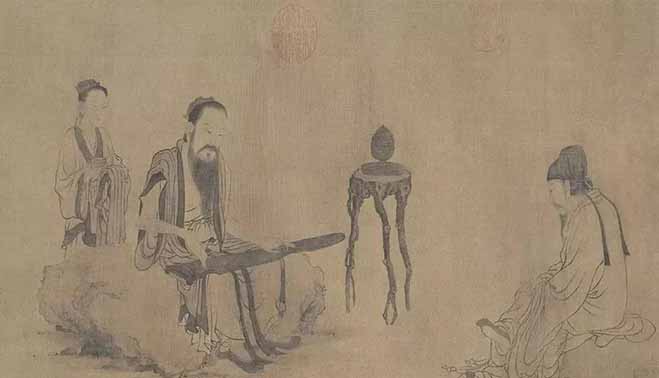
Painting from the Yuán 元 dynasty (1294-1368), representing a sage playing the qín.
The Míng 明 dynasty (1368–1644) was especially important because of the abundance of manuals and musical collections preserved to the present day.
Between the late 19th century and much of the 20th century, social upheaval, wars, and changes in education greatly reduced traditional gǔqín practice. However, in recent decades a notable revival has taken place. Conservatories, universities, cultural associations, and new performers have promoted its study both within and beyond China.
Even so, it remains a minority art requiring time, patience, and a mode of listening uncommon in the accelerated culture of the modern world.
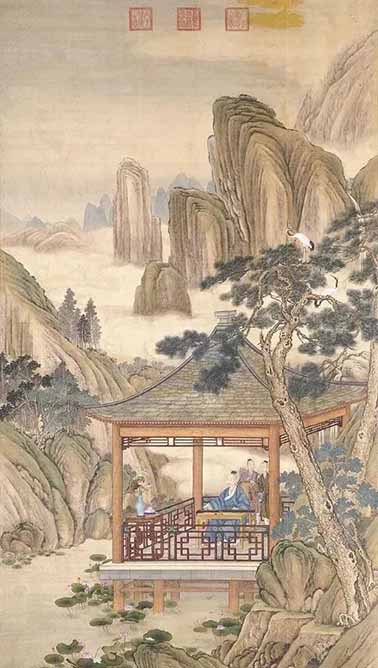
Painting from the Qīng 清 peiord, representing a scholar playing gǔqín, in a natural landscape.
This kind of atmosphere metches perfectly the spirit of the qín.
Notation system
One of the most singular features of the gǔqín is the way its repertoire has been transmitted in writing. Unlike systems that record only pitch and note duration, qín tablatures describe how the sound must be produced: tuning used, string selected, hand positions, fingering, plucking techniques, slides, and other interpretative details. In other words, traditional gǔqín notation indicates not only which note sounds, but also how it should be played.
Throughout history, different transcription systems existed. The most influential—and still used today—is the jiǎnzìpǔ 減字譜 (“reduced-character tablature”), developed during the Táng dynasty from earlier forms of musical writing.
Before its consolidation, more extense systems existed, especially wénzìpǔ 文字譜 (“textual tablature”), which described through complete phrases every movement necessary to perform a note or passage. This method was precise, but also lengthy and impractical.
Jiǎnzìpǔ greatly simplified notation. Instead of full phrases, it uses symbols derived from radicals of Chinese characters, combined to condense a large amount of information into a single sign. These symbols indicate, among other things, which string must be plucked, the specific plucking technique employed, which finger of the left hand presses the string, the position (huī) on the string, as well as subsequent movements such as slides, vibrato, or slurs.
Thanks to this system, a single sign can contain highly detailed performance information.
However, this tablature usually does not fully indicate exact rhythm, so oral transmission and study with a teacher remained essential. The performer must reconstruct phrasing and tempo through tradition, a process known as dǎpǔ 打譜, meaning the modern interpretation of ancient tablatures.
The effectiveness of jiǎnzìpǔ helped preserve the repertoire and partly explains the abundance of musical collections published especially from the Míng dynasty onward, when numerous manuals and compilations of great historical value appeared.
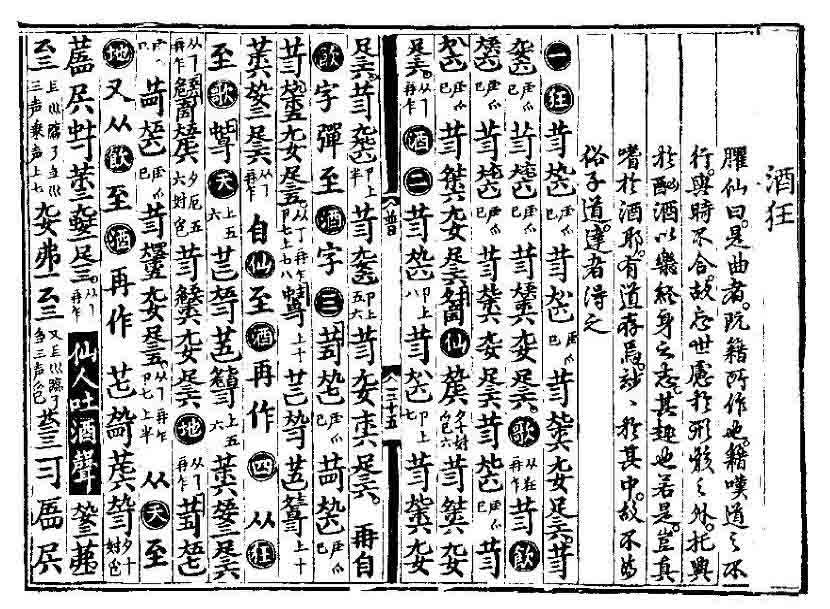
A gǔqín tablature written in jiǎnzìpǔ 減字譜. After the first introductory lines (on the right), the remaining characters are not ordinary characters, but musical notation, and are unreadable to someone who has not studied the qín.